Wys tans plasings met die etiket Animal Welfare. Wys alle plasings

Maandag 06 Februarie 2012

COMPANIES THAT TEST ON DOGS AND OTHER ANIMALS

While I understand that it may be difficult to avoid all products,any effort you make to cut back on purchasing from these companies will save the lives of many animals including cats, dogs, guinea pigs, mice, monkeys, pigs, rabbits, rats, sheep and other innocent animals from pain, cruelty and death.

Please don't use me for research & then kill me, I deserve better!
33 animals die in laboratories per every second that passes - world wide. Yet there are around 450 alternative methods to test product without using animals - and many successful companies round the world use these alternative methods.

Companies that do test on animals commonly use the DraizeTest (all animals that receive this painful test are killed after the test is administered and when the test is administered the animals are not given any type of painkiller) and the LD-20Test (Lethal Dose 50 Test). Many companies also use vivisection - the practice of cutting into or using invasive techniques on living animals.

Research has shown that testing on animals is a highly ineffectiveway to identify products and drugs that are harmful to humans. 

In fact most of the tests done on animals are actually discarded! So, if you are still under the impression that testing on animals is an unfortunate necessity to protect humans from harm you now know otherwise! Most researchers and doctors admit that due to the anatomic and physiological differences between humans and non-human animals the tests are irrelevant! For answers too many frequently asked questions (FAQ) about animal experimentation and why it is not effective or necessary you can click here.

As Aga Khan (Prince Sadruddin) said in 1933, "The philosophy behind vivisection, the sacrifice of creatures we regard as 'inferior' beings, differs little from that behind the concentration camp or the slave trader."

Take a look at the logo’s below - you will recognize many of them- including pet food manufacturers! 

You can then scroll below for a more comprehensive listing which includes many companies that are common household names. Below that listing you can click to see an even more extensive international listing. If you would like to search for a specific company to see if they test on animals - but do not see them listed below you can click here to do a custom search by company name. 

Conversely if you would like to see an extensive list of companies world-wide who do not test on animals you can click here.


A
Alcon Labs
Allergan, Inc.
Answer
Arm & Hammer
ArmorAll
Arrid
Axe
Aziza

B
Bain de Soleil
Ban Roll-on
Banana Boat
Bausch & Lomb
Benckiser
BenGay
Biotherm
Block Drug Co. Inc.
(The) Body Shop
Bounty
Boyle-Midway
Bristol-Myers Squibb Co.

C
Cacherel
Cargill
Carpet Fresh
Carter-Wallace
Chesebrough-Ponds
Church & Dwight
Clarion
Clairol
Clear Choice
Clorox
Commerce Drug Co.
Consumer Value Stores
Coppertone
Coty
Cover Girl
Crest

D
Dana Perfumes
Dawn
Del Laboratories
Desitin
Dial Corporation
Diversey
Dove
Dow Brands
Drackett Products Co.
Drano

E
EcoLab
Eli Lilly & Co.
El Sanofi Inc.
Elizabeth Arden
Erno Laszlo

F
Faberge
Fantastik
Fendi
Final Net
Finesse
First Response
Flame Glow

G
Garnier
Giorgio Armani
Givaudan-Roure
Glade
Glass Plus
H

Helena Rubinstein
Helene Curtis Industries
Herbal Essences
Huggies

I
ISO
Ivory

J
Jhirmack
Johnson & Johnson
Johnson Products Co.
Jovan

K
Kaboom
Keri
Kimberly-Clark Corp
Kiwi Brands
Kleenex

L
Lady's Choice
Lancaster
Lancome
Lava
Lever Brothers
Lipton
Listerine
L'Oreal USA
Lubriderm
Lux
Lysol

M
Mars (candy company)
Matrix Essentials
Max Factor
Maybelline
Mead
Mop & Glo

N
Nair
Naturelle
Neutrogena
Neutron Industries, Inc.

O
Olean
Orange Glo
Oscar de la Renta
OxiClean

P
Pantene
Parfums International
Pearl Drops
Pennex
Pfizer, Inc.
Pine-Sol
Plax
Playtex Corporation
Pledge
Polident
Ponds
Post-It
Prestige Brands
Prince Matchabelli
Proctor & Gamble Co.

Q
Quintessence

R
Raid
Ralph Lauren Fragrances
Reckitt Benckiser
Redken
Resolve
Richardson-Vicks

S
Sally Beauty Supply
Sally Hansen
Sanofi
SC Johnson & Son
Schering-Plough
Scotch
Scott Paper Co.
Scrub Free
Sensodyne
Signal
SmithKline Beecham
Snobal
SoftSheen
S.O.S.
Stanhome Inc.
Sterling Drug
Suave
Sun Star
Sunsilk

T
TCB Naturals
Tegrin
3M
Tide
Tilex
Trojan
Truvia

U
Unilever

V
Vaseline
Vichy
Vidal Sassoon
Visine
Vivid

W
Warner-Lambert
Westwood Pharmaceuticals
White Shoulders
Whitehall Laboratories
Windex
Woolite 

If you would like to view a more extensive world-wide listing you can click here.


Dinsdag 31 Januarie 2012

POUND SEIZURE - BETRAYING DOGS FOR PROFIT

Pound Seizure - Using Dogs for Research, Testing & Teaching

Dogs like these rescues (members of my own dog pack) shown below should have the opportunity to have the life that they deserve to have. Dog's don't get to choose who they live with and what is done to them. Their welfare and their lives are at the mercy of human beings - will they end up with someone who truly respects and loves them or with someone who uses and abuses them - then discards their life as if it is trash, abandons them, leaves them stray. Dogs that end up in shelters, stray, homeless have been let down by society once, making it all the more tragic when they are let down twice. What a dog wants most is to have the opportunity to live the life it deserves to live - to be loved and to give love like only a dog can. 

In this day and age of technology there is no need to test product on dogs and other animals - many other companies are no longer doing so and they are profitable. 

So why do these companies you see listed below still carry out this barbaric practice? 

What possible excuse can there be to justify the ongoing suffering of non-human animals  - including dogs - for the testing of product?

The only real reason is that so many humans are greedy opportunists. To these people making a dollar is everything no matter the consequences, no matter the cost to others, particularly non-human animals - the road to abuse lies wide open.

At the bottom of this article you will find a link to an extensive list of companies that test on animals. Unfortunately the list is very long and you will see many companies listed who you are very familiar with…producing many products that people use and wear on a daily basis. 

If you have never had the opportunity to stop and think about this topic, or do a little research you are probably not aware of the fundamentals of this practice. And let’s face-it the information is not loudly and proudly broadcast by the manufacturers and governmental regulatory authorities who allow and ‘oversee’ the industry. So here are a few facts that you may not be aware of and some things you can do to help ensure the safety of dogs...

What is Pound Seizure?
Animal shelters/pounds and animal control facilities are permitted to sell lost, abandoned, homeless dogs and cats for use in experimentation (research, testing, teaching). This practice is called ‘Pound Seizure’.

Where is Pound Seizure Legal in North America?

Pound Seizure is legal and occurs every day in Canada and the USA.

Ontario is the only province left in Canada where pound seizure is the law. What does this mean?

Well, in Ontario, pounds must hold dogs for three days, and then they can sell the stray pets to Class 'B' Dealers who then sell the dogs and cats to labs that use them for experiments. If there is an order from a laboratory, the pound is required by law, after the three-day waiting period, to provide the animals ordered to the laboratories rather than euthanize or continue to hold them. There are some municipalities in Ontario who understand that this law is wrong and refuse to surrender dogs for research, but there are many more that comply to the law.

In other provinces selling dogs to laboratories is not a law however it is also not against the law - so pound dogs are sold by shelters for research. This means that shelters can choose to do so or not as they wish. Of all the provinces where this practice is a choice, Quebec is the worst offender for selling dogs for research.

Look at These Statistics
In 2007 Companies and Universities in Canada used 15,726 dogs and cats in experimentation. How does this number breakdown by province?

4% Atlantic Canada, (585 dogs and cats);

11% Western Canada - Manitoba, Saskatchewan, Alberta and BC, (1,662 dogs and cats;

33% Ontario (5,130 dogs and cats);

52% Quebec (8,159 dogs and cats).

It should be noted that backyard breeders are also a source of dogs for Class 'B' Dealers.  The following provides some statistics reflecting known numbers of dogs acquired and sold to labs by Class 'B' Dealers in 2008 as noted by the USDA. One must always remember that there are always sales of dogs that are not reported - black market sales.

In the USA, 4,643 dogs were acquired by Class B Dealers in 2008 - the numbers breakdown as follows:
49% from hobby breeders (back-yard breeders) and other individuals;
31% from Class 'B' Dealers;
20% directly from government pounds or shelters. 

The USDA has not issued comparative data for subsequent years. Although the reported numbers show a decline in the number of dogs being used for research, dogs are still being used and killed in the name of research. In the USA, ten-year average 1978 to 1987 -187,464 dogs were used for research; 1998 to 2007 69,223 dogs were used for research.

How Much Do These Companies/Universities pay for a Pound Seizure Dog?
Pound or shelter dogs (also termed ‘random source dogs’) provide a cheap source of supply at about $6.00/per dog. And the available supply is endless.

Can this Research, Testing, Teaching Be Done Without Harming Dogs?
Many researchers, prestigious research facilities, medical schools, etc. in North America, the UK and other parts of the world choose not to experiment on dogs and other animals for moral as well as economic and scientific reasons or simple to obey law. These companies and institutions are proof that products can be developed safely and profitably, students in medical and veterinary colleges can efficiently and fully acquire all required knowledge and skills without causing the pain, suffering and death of innocent living beings.

Supposed human entitlement is a very weak reason to sentence even one dog's life (let alone many) to suffering and death.

What Research, Testing & Teaching Means Pertaining to Dogs

Every year, tens of thousands of dogs are used in drug-toxicity studies in Europe and North America. The researchers start their testing program by giving the dogs a dosage that will kill. Then they take another group of dogs and scale the dosage back so it causes severe suffering but not immediate death. And so on, reducing the dosage on other dogs until they achieve the result desired. All of the dogs suffer terribly and then die.

Cosmetic companies, companies producing household cleaners and so on do the same kind of testing. Dogs are left to suffer with major parts of their bodies chemically burned, internal and external wounds, induced failure of organs and so on. Again, the dogs suffer and die - most often their death is slow and painful.

Many Universities use dogs for veterinary learning - operating on the dogs so the students can learn procedure and then they euthanizing the dogs when they are still under anesthetic. Some of the dogs are operated on more than once - depends on the university. Some universities put the dogs on treadmills forcing them to exercise until the dog's heart bursts. The Universities carry out many such atrocities on dogs - and to think that they where all someones 'pet' at one time. What a betrayal of a sacred trust!

So, If You Have to Give Your Dog-up for any Reason…

Make sure you DO NOT surrender your dog to a shelter unless you are 100% certain that they do not participate in Pound Seizure. 

Instead surrender your dog to a reputable, certified rescue group. Many people have given their dog’s up to Shelters because they felt another person would be able to give the dog a better life - more attention, exercise and so on. When they check back to see the adoption status of their former dog some of these people have found out that the dog was either subject to Pound Seizure or he shelter choose to sell the dog to a research lab. Although the people surrendered the dog with the best intention - for the dog’s welfare - the dog ended up dead.

At least if the dog had been simply euthanized by the shelter, the dog would have passed away in some sort of peace rather than alone in confusion and agony.

Dogs Should be Cherished by Humanity

How can we have laws for to prevent cruelty to dogs and then turn around and allow dogs to be used for 'research'.  

How many times does a dog have to suffer? 

Dogs who end up in 'shelters' have already been let down by humanity. Dogs don't get to choose who they live with and what is done to them. Their welfare and their lives are at the mercy of human beings - will they end up with someone who truly respects and loves them or with someone who uses and abuses them - then discards their life as if it is trash, abandons them, leaves them stray. What a dog wants most is to have the opportunity to live the life it deserves to live - to be loved and to give love like only a dog can. 

All though I see all of the terrible things that mankind does to dogs, I will never understand how ‘civilized’ people and a ‘civilized’ nation can:

A - Sanction Pound Seizure;

B - Not make it illegal to sell of stray, abandoned, homeless dogs for research, testing, teaching;

C - Not make it illegal to breed dogs specifically for research, testing, teaching - this is just as wrong. 

To endorse or silently allow any of these things is no different than using dogs as bait and fight dogs in dog fighting - another brutal painful and deadly connivance of mankind.  It is no different than killing dogs for meat (as the Chinese, Indonesia, Korea, Philippines, Taiwan, etc.).

Are There any Organizations Striving to See Pound Seizure Reform?

Groups such as the Animal Alliance continue to work tirelessly to create awareness and push reform. As a result of their ongoing efforts Guelph University and the Ontario Veterinary College have voluntarily made reforms to their policies to ensure that no more pound dogs will be used for teaching or experimentation, that dogs who are used for skills training will be ‘recovered’ and adopted out, and that no more dogs will be killed for practice surgeries. While this is a great step forward, there are many other institutions and companies in the province of Ontario who have not made any such reforms. 

What You Do to Help Affect Change

One - Well you can become an advocate of change by spreading the word about Pound Seizure - most people do not even know that this occurs!

Two - You can sign petitions. Although you may not think this worth the time and bother - I can tell you that it is. When enough people sign governments are forced to pay attention. I have and will continue to sign many petitions against Pound Seizure in Canada, the US and around the world. Here are some sites that you can visit which host a lot of animal welfare petitions.


Three - You can reduce the number of products that you purchase from companies that test on animals;

Four - If you live in the Province of Ontario Canada, Animal Alliance has laid out some steps that you can follow to take action. The following is an excerpt from their site:

Animal Alliance prepared a document entitled The Political, Animal Services, and Scientific Case AgainstPound Seizure regarding the arguments against pound seizure and how such practices stop the implementation of progressive animal services programmes. To find out about animals in your area, you can mail your municipality a Freedom of Information request - a sample letter is available by clicking here. Also available for download is a document regarding teaching alternatives for veterinary students.’
We need to keep the pressure on the Honourable Dalton McGuinty, Premier of Ontario, and the Honourable Jean Charest, Premier of Quebec, to bring in legislation banning the use of lost pets in research. So please, mail and call them. Hand-written letters are best but you can also print our sign-on letter by clicking here.

The Honourable Dalton McGuinty
Premier of Ontario

Legislative Building
Queen's Park
Toronto, ON M7A 1A1
Tel: 416-325-1941
Fax: 416-325-3745

Premier of Quebec
Édifice Honoré-Mercier, 3e étage
835, boulevard René-Lévesque Est
Québec (Québec) G1A 1B4
Tel: 418-643-5321 / 514-873-3411
Fax: 418-643-3924 / 514-873-6769

Do you know if the manufacturer of your dog's food tests on animals? Even some pet food companies test on animals! The same type of cruel, abusive, lethal research that I talked about above! If you would like to make sure that the pet food products that you are buying are not tested on animals (including on dogs)... 

A  - if you live in North America, you can click here to see a list of pet food companies that DO NOT test on animals;


B - if you live in the UK, you can click here to see a list of pet food companies that DO NOT test on animals.
If you would like to see a comprehensive list of companies that manufacture many common household and personal hygiene products that DO test on animals just click here. You will be shocked to see how many of the products that you use daily have been tested on animals!

If you would like to further action to stop Pound Seizure and the Class 'B' Companies who purchase dogs to sell for research/testing you can visit this site to sign petitions and learn more.

Maandag 23 Januarie 2012

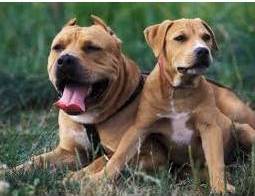
ALL ABOUT PIT BULLS


First, Did you Know…

A Pit Bull is not a breed of dog, instead it is a term used to generally describe individual breeds of dogs that all have similar characteristics, the most common of which are...

One - American Pit Bull Terrier;


Two -  American Staffordshire Terrier; and


Three - Staffordshire Bull Terrier, short form name - ‘Staffy’.


If you would like to further test your ability to identify a Pit Bull you can click here. 

There are many other breeds that fall into the 'Bully Breed' class - for example the Bulldog, Bull Mastiff, Boxer, Boston Terrier, French Bulldog, Olde English Bulldog and more!

The Pit Bull breeds were originally developed during the 19th century by crossing Bull Dogs and Terriers. Breeding focused on attaining characteristics to attain a good ‘fighting’ dog (if indeed that can be good at all - to me it is shameful that any human would want to use dogs to fight each other or another animal for human entertainment and monetary gain). To this purpose breeding was tailored to develop traits that were desirable in a fighting dog. Traits such as…

- High tolerance for pain (this just makes me very sad);

- High prey drive (like many dogs such as hounds);

- Strength and agility (like many dogs such as the German Shepherd and Boxer).


Despite the fact that many people today - upon hearing the word ‘Pit Bull’ immediately think of aggression towards humans - this was one trait that the three breeds did not have…and that this till holds true for Pit Bulls of today. Back in the 19th century Pit Bulls were family ‘pets’ and pre-fight / during the fight they required a lot of handling by their humans - so reactive-aggressive behaviour to humans was not bred into the Pit Bull. And as to Bully Breeds being more aggressive than other breeds of dogs...in 2002, the Center for Disease Control (CDC) in Atlanta Georgia carried out a study that proved there are no specific dog breeds that are inherently viscous.


Some people believe also believe that  Bully Breeds have superior jaw strength enabling them to lock down on a victim like no other dog can. In 2005, National Geographic conducted a study to measure the bite force of various breeds of dogs. The bite force of the Bully Breeds proved to be less than that of other breeds such as the German Shepherd and the Rottweiler...and both of these breeds are no less likely to be great companions than the bully and other breeds!

The term 'Pit Bull' originated in England. During the Medieval period of the 1200's, bull baiting arrived in England - bull dogs were used to bait the bulls. Both bull and bear bating were a popular form of 'entertainment' considered as a sport and opportunity for gambling. In the 1800's Bull Dogs were breed with Terriers to create a faster more agile dog for bull baiting events. In 1835, both bear and bull baiting were prohibited when an act was passed in Parliament to stop the brutal sport. Unfortunately, today there are many places in the world were dog fighting still occurs legally and illegally. Pit Bull's are used both as bate and fighting dogs - having no choice but to participate they are cruelly treated, live a short life of pain and suffering all for the entertainment of humans. I am often struck by the thought that humans have advanced very little over the ages.

Today, Pit Bulls are probably the most feared and legislated-against (restricted and banned) dog in the world. Yet, in locations were they are not so treated, Pit Bulls are well known and loved family pets who not only get along with children but with other animals. They also excel at Agility, Fly Ball, Soccer and other such activities. Many Pit Bulls also work as Registered Therapy Dogs and other occupations such as Search and Rescue. 

So how did the Pit Bull get such a bad rap? 

Well, years ago it was the Rottweiler, the Doberman, the German Shepherd, the Boxer and the list goes on. All it takes is one incident and the media’s quest to sell their copy fuels the fire. The media knows humanity’s lust for blood and sensationalism and the media will get as much mileage out of a story as it can. The end result - the populace shifts their fear from one breed to another. And the more stories that can be found the bigger the stigma grows. 

It really is that simple. 

The sad thing is that most people do not even know what a Pit Bull really looks like and most reported ‘Pit Bull’ attacks - at least eight out of ten are not actually Pit Bulls! 

Think about this statistic…in 2006, an estimated 72 million dogs lived in households in the U.S. (U.S. Pet Ownership & Demographics Sourcebook (2007 Edition)How many of these dogs are purebred, pedigreed, and registered, less than you might think - the very liberal estimate is maybe 25%. So 75% of the dogs in North America are not purebred. Further supporting the fact that most dogs attacks reported as being perpetrated by Pit Bulls simply are not. 

Overall fatal incidents from dog attacks in general are extremely rare. About 75 million dogs reside in the US today. About 32 fatal dog attacks occur each year. To better understand how out-of-kilter most people’s concept of dog attacks are take a look at purely human attack fatalities. The human population of the US is about 300 million (4x the dog population). Humans in the US murdered 16,000 humans (500x the number of dog-related deaths). 

So one the whole, not only are dogs much less dangerous to humans than humans are, but the number of actual Pit Bull related attacks are extremely low. Here is a great bit of information to put things in a little more perspective…

In 2002 the American Temperament Testing Society statistics showed that American Pit Bull Terriers, American Staffordshire Terriers (both ‘Pit Bull breeds’) and Rotweillers passed the good temperament test +80% of the time. A very high passing grade! Other common family dogs did not fare as well. For example Golden Retreivers and Bichon Frise received a 77% rating, Chihuahuas and Lhasa Apsos received 71% (you can view the test results at the American Temperament Test Society .

Recently the American Temperament Testing Society carried out another round of tests - pit bull terriers received a very high passing rate of 90.6%. The average pass rate for the other 121 breeds tested was 77%. The tests involve putting each dog through a series of unexpected situations - including involvement with strangers. Pit bulls have been proven - once again NOT to be inherently aggressive. Aggression in an individual dog, any breed - is a result of acquired behavior - forced on the dog by a human.

So, How About Taking a Look at Just How Sweet Pit Bulls Really Are…

Well, you can start with this Yes, Pit Bulls Suddenly Snap;

And then take a look at this Gentleman Duke - A bait Dog’s Salvation;

And lastly this Pit Bull Bigotry - Public Perception and Legislation.

For those of you who are not sure what a bait dog is - Pit Bulls are still used to day in legal (in some US States) and illegal (in other US States and Canada) dog fights. To train the dogs to attack another dog ‘bait’ dogs are used. Dogs that are submissive, sweet natured dogs are used as bait dogs. They end up severely injured, live a short life of torture and pain and then are killed - some are lucky enough to be rescued. Duke is one such dog. 

So, the next time some one says something bad about a Pit Bull, I am hoping you will stand-up and say - ‘hey wait a minute, you are wrong and here is why’. 

I will be following this article up with one on Breed Specific Legislation - which sees a lot of Pit Bulls condemned to death in Canada and the USA.
 
One Last Thing - You Can Help Pit Bulls In Ontario 

If you agree Pit Bulls are not the evil demons that the media and others have made them out to be, and would like to see them treated as they should be in Ontario - as loved and respected canine members of society -  you can help make sure that the ban on Pit Bulls is repealed by signing this petition. You may not be aware but (shame) Ontario is one of those places that instituted Breed Specific Legislation against Pit Bulls. 

Breed-specific legislation restricts people from having dogs based on dog breed.This requires breed identification of each and every dog. As noted above, this gets into murky water as there are far more cross breed dogs in North America than there are pure breed registered dogs. Most mixed breed dogs are a genetic conglomerate resulting from more than one generation of mixed breed dog interbreeding. In addition, a dog that doesn’t meet any single breed standard may be categorized as a type of dog rather than a specific breed, i.e. a Shepherd, a Terrier, a Pit Bull. This means that the primary means of identification for a mixed-breed dog is a visual glance followed by a guess - very subjective. Pretty much the same way the media identifies a ‘Pit Bull’ as the guilty dog in an attack. 

Ontario Attorney General Michael Bryant, who pushed for this ban on Pit Bulls in Ontario, proposed this manner of identification:

“I’ve said before and I will say again, if it walks like a pit bull, if it barks and bites like a pit bull, wags its tail like a pit bull, it’s a pit bull.” (Ontario Hansard 38-1, November 4, 2004.


And so it stands. Make no mistake BSL is racism, to make things worse it is racism born of ignorance and it is lethal. Many Pit Bulls and dogs who people think may be Pit Bulls are put to death because of this legislation. Euthanized, gassed to death, heart sticked and so on.

So here is how you can help…

Randy Hillier, MPP for Lanark-Frontenac-Lennox and Addington, tabled a bill in Queen's Park to repeal the breed-specific legislation passed by the McGuinty government in 2005, commonly known as the “pit bull ban”. Subsequently Randy created a website and a petition to help support the bill to repeal the ban, just click here .

Thanks for reading this, every little bit we do to help change the perception of Pit Bulls can save a sweet misunderstood dog’s life! We can change the future and make it a better place for dogs.

References:
Stop BSL http://stopbsl.com/
KC Dog Blog http://btoellner.typepad.com/kcdogblog/
American Temperament Society http://atts.org/


Aangedryf deur Blogger.

Labels